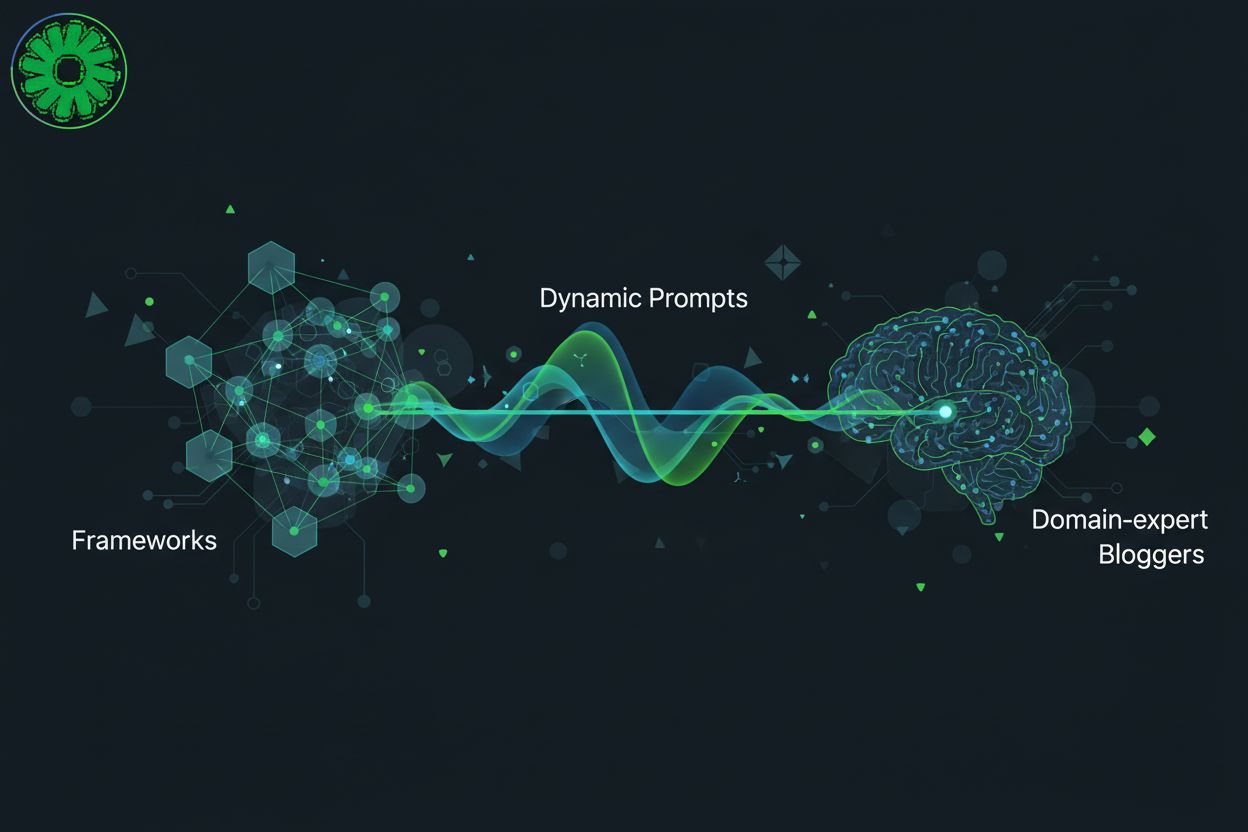
Dynamic Prompt Engineering Frameworks for Domain-Expert Bloggers

TL;DR
- This article covers the shift from basic ai writing to advanced prompt engineering frameworks designed for domain experts. You will learn how to use structured methods like COSTAR and CRISPE to keep your content authentic while using ai tools for blogging and educational resources. We explore ways to humanize content and ensure digital content creation stays high quality and bypasses robotic paraphrasing.
The evolution of blogging in the age of ai
Ever feel like you are shouting into a void when you use ai for your blog? I spent three hours yesterday trying to make a bot sound like a human expert, only to get back a list of "top tips" that sounded like a 1990s toaster manual.
The truth is, most of us start with one-sentence instructions. We tell the machine "write a blog post about healthcare trends" and then we're shocked when it's boring. According to industry experts at Parloa, weak prompts are usually why ai hallucinations happen or why the quality is just... bad. It's about the "initial conditions" you set.
- The Generic Trap: Without a framework, you get "bespoke" content every time—which sounds fancy but actually just means it's inconsistent and doesn't scale.
- Brand Erosion: If you're a finance expert, you can't afford a bot that uses wrong terminology. Generic outputs hurt your authority because readers can tell when you've just pressed "generate."
- Architect vs. Writer: You gotta stop being just a writer and start being a "prompt architect." It's about building a blueprint for the ai to follow.

So, what even makes a post "human" in 2025? It's the stuff ai can't fake—like that time you had to explain a complex tax loophole to a client who was panicking.
"Prompt engineering is the process of drafting inputs to guide an LLM’s behavior... it influences how it reasons and prioritizes information." — Parloa Knowledge Hub
You have to bake your personal anecdotes into the prompt itself. If you don't give it the "human" bits, it'll just fill the gaps with fluff. It’s a balance of speed and original thought, you know?
Next, let's look at the actual frameworks that help you stop guessing and start getting real results.
Core frameworks for the expert blogger
Ever wonder why some bloggers get perfect drafts on the first try while the rest of us are stuck arguing with a bot about why "leveraging synergies" sounds like a corporate fever dream? It usually comes down to the blueprint you're using before you even hit enter.
If you're tired of ai rambling, COSTAR is basically your best friend because it treats the prompt like a project brief. It stands for Context, Objective, Style, Tone, Audience, and Response—which sounds like a lot, but it keeps the machine from guessing what you want.
- Setting the Scene: You gotta give it the "why" (Context). If you're a healthcare blogger, tell the ai it's writing for a busy surgeon, not a med student.
- The Expert Persona: This is where you fix the rambling. By defining a specific "Style" and "Tone," you stop it from using those annoying fluff words and make it stick to the facts.
- Response Formatting: Tell it exactly how you want the output—like "markdown with H3 headers" or "a table comparing three models."

Honestly, I used this for a technical tutorial last week on api integrations. Instead of a mess, I got a clean guide because I told the ai to act as a "Senior Dev" (Style) with a "no-nonsense" (Tone) for "Junior Engineers" (Audience). It actually worked on the first try.
Now, if you're doing deep dives—think finance or legal blogs—you need CRISPE. This one is more about the "how" of the thinking process:
- Capacity: Define the role (e.g., "Act as a Senior Research Analyst").
- Role: Give it a specific job within that capacity.
- Insight: Provide the background data or unique perspective you have.
- Statement: Tell it exactly what you want it to do.
- Polishing: Define the level of editing or "vibe" check needed.
- Experiment: Ask for multiple variations to see what works.
It's really about moving from being a "writer" to being an "architect." You're building the walls and the roof with these frameworks so the ai doesn't wander off into the neighbor's yard.
Next up, we’re gonna look at how to layer these frameworks with your own personal stories so the content feels real, not robotic.
Humanize content and avoiding the robotic feel
Ever feel like you’re reading something and just know a bot wrote it because it’s too perfect? It’s like eating a plastic apple—looks great, but there is zero soul in it.
The problem is that most ai tools are trained to be "helpful" and "polite," which usually just ends up sounding like a corporate brochure from 2005. If you want your blog to actually connect with people, you have to break the machine's habit of being boring.
- Robotic Patterns: ai loves a predictable rhythm. It uses the same sentence length over and over, which is a dead giveaway for detectors.
- The "Safety" Filter: Most models are so scared of being offensive that they strip out all the spicy opinions or "bursty" language that makes a human voice interesting.
If you want to keep your work accessible and free for everyone, you should check your drafts against something like gpt0.app to see where the "bot-speak" is peaking. It's not just about hiding from detectors; it’s about making sure your writing has "perplexity"—a fancy way of saying it’s unpredictable and engaging.

I remember trying to write about tax law last month. The ai kept saying "it's important to be compliant." No kidding! I had to go in and add a story about a client who almost lost their house because of a tiny filing error. That’s the stuff people actually read.
Next, we’re going to dive into some advanced techniques for when you need the ai to handle really complex, educational stuff.
Advanced techniques for educational resources
Ever feel like your lesson plans are just a bit too... linear? Like you're missing the weird, "what if" questions a student might actually throw at you in the middle of a lecture?
When you are building educational resources, the biggest hurdle isn't just getting the facts right—it's making sure the logic holds up under pressure. That is where some of the more "brainy" frameworks come in handy for us creators.
If you have ever used chain-of-thought prompting, you know it's basically asking the ai to "think step-by-step." But for a complex curriculum, that’s sometimes too simple. You need the Tree of Thought (ToT). Instead of one straight line, you ask the ai to branch out. It explores multiple paths for a single lesson, critiques them, and then picks the best one.

Nothing kills an online course faster than a "robotic" voice that suddenly switches styles halfway through. If you want the ai to sound like you, you gotta give it a few "shots" (examples) of your actual work.
I usually dump 3-5 of my best past blog posts into the prompt and say, "Analyze the rhythm and vocabulary here. Now, use that exact style to explain how interest rates work."
- The Style Guide Prompt: Don't just ask for a "friendly tone." Provide examples of how you handle complex jargon. Do you use metaphors? Do you make dad jokes? Show, don't just tell.
- Reducing Edit Time: When you give the model these "shots," you aren't spending two hours fixing weird phrasing later. It catches your "voice" much faster.
Honestly, I tried this with a finance guide last week. I gave it some of my old newsletters, and the draft it spit out actually used my favorite phrase—"it's a bit of a toss-up"—without me even asking.
Next, we’re gonna look at how to use external data so the ai actually knows what it's talking about.
The role of RAG and external data in blogging
Ever feel like your ai is just making stuff up because it doesn't actually know your business? It's like asking a stranger to write your autobiography; they might guess the basics, but they’re gonna miss the soul and the facts that actually matter.
This is where Retrieval-Augmented Generation (RAG) comes in, and honestly, it’s a total game changer for us bloggers. Instead of the bot just pulling from its training data, you're basically giving it a library of your own research, past posts, and niche data to look at before it even starts typing.
Think of rag as an "open book exam" for the ai. It stops the machine from hallucinating because it has to cite its "sources" from the folders you provide.
- Your Private Knowledge Base: You can connect your ai tools to your own research folders or even your old newsletters.
- Industry Specifics: In fields like healthcare or legal, terminology is everything. By feeding the ai your specific documentation, you ensure it uses the right jargon without you having to fix it every five minutes.

I tried this with a deep dive on retail supply chains last week. Usually, the ai gives me generic stuff about "efficiency," but because I hooked it up to some specific industry reports, it actually caught a weird edge case about warehouse automation that I’d forgotten.
As mentioned earlier by the Parloa Knowledge Hub, this kind of "context injection" is what makes the difference between a bot that sounds like a student and one that sounds like a pro. It’s moving away from just "writing" and into building a real content infrastructure.
Next, we’re gonna look at where the future of all this is headed and how to stay compliant.
Future trends in prompt engineering and compliance
So, we’ve covered a lot of ground, but where is all this actually heading? If you think prompt engineering is just about getting a better blog post today, you're missing the bigger picture—it's quickly turning into the actual "piping" for how we create anything online.
As we move toward 2026, just hitting "generate" isn't gonna cut it anymore, especially if you're in a high-stakes field like finance or healthcare. Compliance teams are starting to treat prompts like legal contracts. They want to see the "receipts" of how a bot reached a certain conclusion.
- Traceability is huge: You'll need to keep logs of your prompts. If a medical blog gives weird advice, you need to prove your prompt had the right "guardrails."
- Programmatic Prompting: Tools like dspy are making it so you don't even have to tweak the words yourself. dspy is basically a framework that lets you programmatically optimize your prompts so the ai learns how to get better results on its own.
Honestly, the biggest shift is that prompt engineering is becoming "infrastructure" rather than a niche hobby. As noted earlier by the parloa knowledge hub, small changes in your "initial conditions" lead to massive differences in what you actually get back.
Don't get overwhelmed, though. At the end of the day, it's still about your voice. These frameworks just make sure the machine doesn't drown it out. So, keep experimenting, keep breaking things, and most importantly—keep it human. You got this.