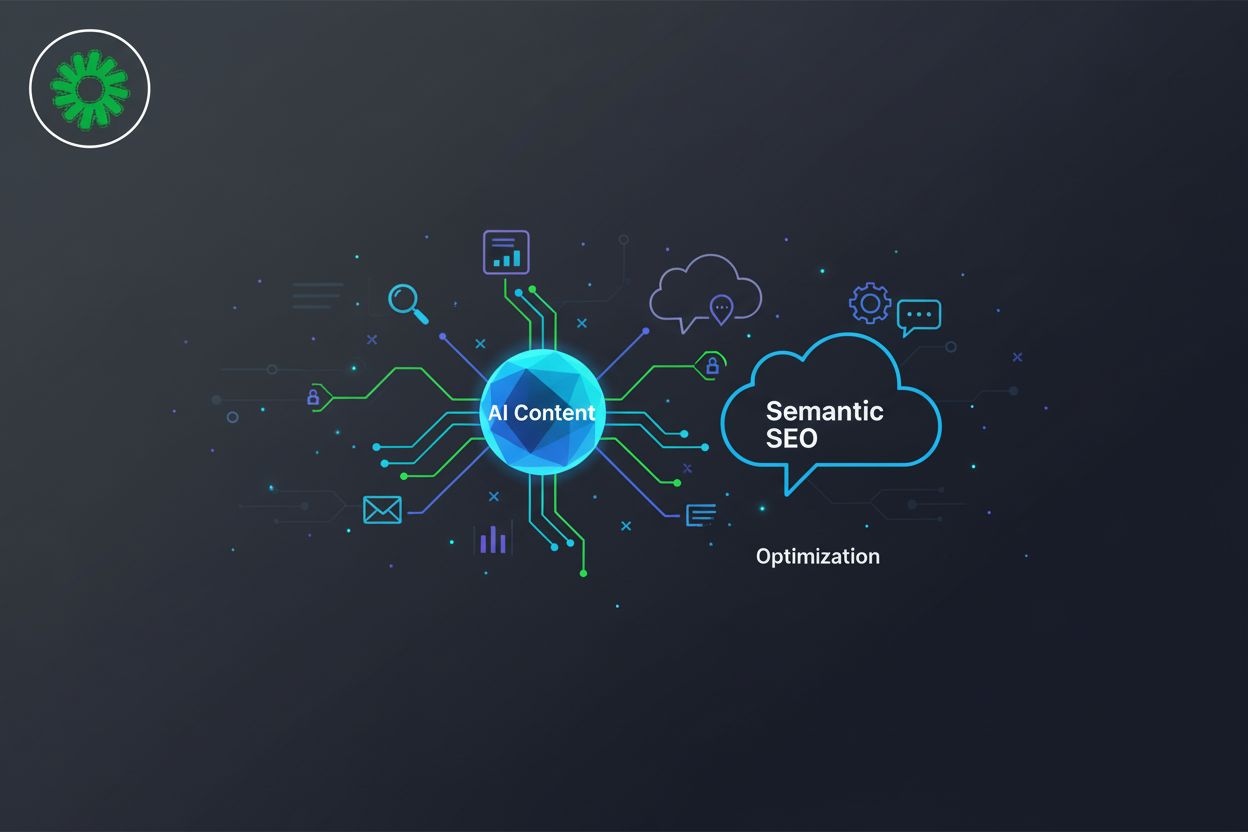
The Role of Semantic SEO in AI Content Optimization

TL;DR
- This article dives into how semantic seo and ai writing tools are changing digital content creation. It covers understanding user intent, optimizing ai-generated content for search engines, and maintaining content authenticity. Educators and content creators will gain insights into improving online visibility and engaging target audiences effectively.
Understanding Semantic SEO: The Foundation for AI Content
Did you know that about 70% of online experiences begin with a search query? It's kinda wild to think about, right? That's why understanding how search engines really work is super important.
Semantic SEO? It's not just about throwing keywords around like confetti anymore. It's about figuring out what users actually mean when they type something into that little search box. Like, what's the intent, the context, the whole shebang.
Here's the deal, broken down:
- Semantic SEO is about understanding user intent and the relationships between words. Forget just matching keywords; it's about grasping the meaning behind those keywords and delivering content that truly answers the user's question. Think of it as search engines getting smarter and more conversational.
- The shift from keyword stuffing is crucial. We've all seen those websites from the early 2000s that were just walls of text with the same word repeated over and over. Nowadays, search engines are way more sophisticated, and they penalize that kinda stuff.
- Better User Experience is the goal. Ultimately, semantic search aims to give users the best possible experience. When search results are relevant and helpful, users are more likely to engage with the content and come back for more.
Search engines aren't dumb anymore. They've evolved, big time. Google's Hummingbird and RankBrain updates, for example, are all about understanding the concept behind a search, not just the words. They use natural language processing (nlp) to get what you're really asking.
Think about it: if you search "best Italian restaurants near me," the search engine doesn't just look for the words "Italian," "restaurants," and "near." It understands you're hungry, you want food, and you're probably looking for a place you can get to easily. That's semantics in action.
This shift is, tbh, pretty awesome. It means content creators can focus on making genuinely great stuff that helps people, rather than trying to trick the system. According to The Role of Artificial Intelligence in Semantic SEO, SEO has come a long way from mere keyword stuffing to advanced content optimization strategies.
And what's the payoff? Content that aligns with what people expect, builds trust, and boosts your brand's reputation. Seriously, who doesn't want that?
To truly grasp how search engines evolved from simple keyword matching to understanding entire concepts, we need to look at how they process information. This involves understanding entities, context, and the relationships between different pieces of information.
AI Writing Tools: Revolutionizing Content Creation
AI writing tools, huh? Are they a gift or, like, the beginning of the end for us writers? Well, maybe it's a bit of both. They're changing things, that's for sure.
The leap search engines made to understand concepts is precisely why AI writing tools have become so relevant for semantic SEO. These tools, when guided correctly, can help us create content that aligns with this deeper understanding.
- Content generation: Tools like GPT-3, Jasper, and Copy.ai can pump out articles, blog posts, and even marketing copy in, like, seconds. It's kinda crazy, right? To make them effective for semantic SEO, you need to guide them. Instead of just asking for "a blog post about dogs," you'd prompt them with something like: "Write a comprehensive blog post about the benefits of adopting a rescue dog, focusing on the emotional and practical advantages. Include sections on common misconceptions about rescue dogs and tips for successful integration into a new home. Use related terms like 'shelter pets,' 'second chances,' 'canine companionship,' and 'responsible pet ownership'." This prompts the AI to think about related concepts and entities, not just the main keyword.
- Paraphrasing: Need to reword something? AI can do that too. Might be helpful if you're trying to avoid plagiarism, or just want to make something sound a bit different.
- Grammar and spell checking: AI-powered grammar tools are getting seriously good. They can catch errors that even the best human editors might miss.
These AI tools are not just for churning out mountains of content, though. It's changing how content creators work, freeing them up to focus on strategy and, ya know, being creative.
Imagine a healthcare company needing to explain a complex medical procedure. AI could generate a first draft which the company's experts can then refine and ensure it aligns with their brand.
Or, think about a retail business that wants to automatically generate product descriptions for thousands of items. AI can handle the bulk of it, and humans can tweak the descriptions for the top-selling products. Now that's efficient.
Integrating Semantic SEO into AI Content Strategy
Alright, so you've got all this amazing AI-generated content, but how do you make sure it actually works for your SEO? It's not as simple as just letting the AI run wild and hoping for the best, trust me.
Integrating semantic SEO into your AI content strategy is like giving your AI a brain upgrade. Instead of just spitting out words, it's about teaching it to understand the meaning behind those words. Here's how you do it:
- Keyword research for topic clusters: Forget just targeting individual keywords. Think about creating topic clusters around broad subjects. So, instead of just "content marketing," you might have a cluster about "content strategy," "content creation," and "content distribution." This helps search engines understand your authority on a broader topic.
- AI-powered semantic analysis. Tools like Google's BERT (Bidirectional Encoder Representations from Transformers) help AI understand content like humans do. BERT, and similar NLP models, can be utilized by content creators by understanding how they interpret text. For example, if you're using an AI writing tool that integrates BERT, you might see suggestions for rephrasing sentences to be clearer or more contextually relevant. You can also use standalone tools to analyze your content's semantic strength, seeing if it covers related entities and concepts.
- Answer user questions: What are people really asking? Focus on answering those questions directly in your content. Use long-tail keywords to get specific.
It's not enough for the AI to understand; search engines need to get it too.
- Structure your content: Use headings, subheadings, and bullet points to make it easy to read.
- Incorporate relevant entities: Think about the key concepts related to your topic and weave them in naturally. For example, if you're writing about "semantic SEO," you'd naturally include entities like "search engines," "user intent," "keywords," "NLP," and "AI."
- Optimize meta descriptions: Make sure your meta descriptions accurately reflect the content and include relevant keywords. AI can assist here by generating multiple meta description options based on your content, allowing you to choose the most compelling and semantically relevant one. A good semantically optimized meta description goes beyond just keywords; it should convey the core topic and entice clicks by hinting at the value proposition for the user.
So, how do you know if your AI content is really hitting the mark? Well, that's where tools like GPT0 come in. They can help you humanize your AI content to make it more authentic.
AI-Powered Tools for Semantic Content Optimization
AI-powered tools? They're not just a shiny new toy; they're kinda essential for making semantic SEO actually work. I mean, trying to do it all manually? Forget about it.
Let's clarify the categories of AI tools and their specific roles in semantic SEO:
- Natural Language Processing (NLP) Tools: These are the foundation for understanding language.
- Models like Google's BERT and OpenAI's GPT models: These are game-changers. They can understand the context and nuances of language, which is, ya know, kinda important when you're trying to figure out what someone really means when they type something into Google. They don't just see keywords; they get the whole vibe.
- How to leverage them: These tools analyze both search queries and content to figure out the underlying intent. Like, are they looking to buy something? Are they trying to learn something? Or are they just browsing? The AI figures it out. For example, a user searching "how to bake a cake gluten-free" isn't just looking for recipes with those words. They need instructions, ingredient lists, and maybe even tips on avoiding common mistakes. NLP helps surface that type of content.
- Machine Learning (ML) Algorithms: These tools learn from data to personalize and predict.
- Personalization: ML algorithms personalize content based on user behavior. They track what people click on, how long they stay on a page, and what they do next. It's like having a super-smart assistant who's always watching and learning.
- Predictive Analytics: These anticipate user needs. If someone's been reading articles about sustainable fashion, the algorithm might suggest content about eco-friendly brands or tips on reducing waste.
- Dynamic Content: This adapts to individual preferences. A news website, for instance, could show different articles to different users based on their past reading habits. It's all about making the experience more relevant and engaging.
- Semantic Search Platforms: These platforms integrate AI to provide better search experiences.
- Platforms like Algolia and Yext: These use AI to power their search engines, and it's a big deal. They understand user queries contextually, which means they can deliver more accurate and relevant results.
- How content creators can use them: While you might not directly "use" these platforms for content creation, understanding their capabilities helps you optimize your content for them. For example, if you're building a website that needs a robust internal search function, choosing a platform like Algolia means your content needs to be structured and tagged in a way that the AI can easily understand relationships between terms and concepts. This means focusing on clear headings, entity recognition, and providing comprehensive answers to potential user queries. These platforms improve search accuracy, which leads to better user engagement and higher conversion rates. If someone finds what they're looking for quickly, they're more likely to stick around and maybe even buy something, right? Think about an e-commerce site. If a user searches for "red dress," the platform won't just show any red dress. It'll consider the user's past purchases, their size, their style preferences, and even the season to show them the perfect red dress.
So, what's next? We'll deep dive into giving your AI content that human touch.
Case Studies: Real-World Applications of Semantic SEO and AI
Did you know that semantic SEO and AI are making waves in the content world? It's not just theory; businesses are seeing real results.
- E-commerce: One e-commerce platform used NLP to sift through customer reviews. What they did was use that data to fine-tune product recommendations. The result? Happier customers and, yep, more sales. It's pretty cool how understanding customer sentiment can directly boost your bottom line, right?
- Content Publishers: A news portal optimized their articles for semantic SEO. They tweaked content based on what users were actually interested in. It's not just about the main topic, but the little sub-topics people are digging into. Organic traffic shot up, and engagement went through the roof.
- Marketing Firms: A digital marketing firm used machine learning to predict what keywords would be trending. By creating content before the trends hit, they positioned their clients as thought leaders.
These examples show that AI and semantic SEO are more than just buzzwords, they're a real deal. Next up, we'll dive into some of the challenges that come with using AI in SEO.
Challenges and Ethical Considerations
Data privacy is a big deal, right? But how do we manage it when AI's involved? Well, it's not always a walk in the park.
- Data Privacy Concerns and GDPR Compliance: When AI analyzes a ton of user data to understand behavior, it's easy to cross privacy lines. For instance, healthcare providers using AI for semantic analysis must ensure patient data is anonymized and used in compliance with HIPAA. To mitigate these issues, content creators should:
- Be transparent: Clearly inform users about what data is being collected and how it's used.
- Anonymize data: Whenever possible, remove personally identifiable information before feeding data into AI models.
- Seek consent: Obtain explicit consent from users before collecting and processing their data.
- Regularly audit data usage: Ensure AI systems are not overstepping boundaries and are compliant with regulations like GDPR and HIPAA. It's not just about following the rules; it's about building trust.
- Bias in AI Algorithms: AI learns from data, and if that data is biased, the AI will be too. Imagine a recruiting tool trained on data that predominantly favors male candidates; it might unfairly downrank female applicants. To address bias, content creators can:
- Use diverse datasets: Ensure the data used to train AI models is representative of the target audience.
- Regularly audit AI outputs: Look for patterns of bias in the AI-generated content or recommendations.
- Implement fairness metrics: Use tools and techniques to measure and improve the fairness of AI algorithms.
- Human oversight: Always have human reviewers check AI-generated content for potential bias before publishing. Regular audits and diverse datasets are key to fixing this.
- Avoiding Over-Reliance on AI: AI can make things easier, but overdoing it can lead to generic, uninspired content. Think about a financial firm that uses AI to generate all their market analysis reports. Without human oversight, reports might lack critical insights and sound...well, robotic.
Ethical AI use means staying human and creative. Next up, we'll look at what the future holds for AI in SEO.
Future Trends: The Evolving Landscape of AI and Semantic SEO
Okay, so what's next for AI and semantic SEO? Things are about to get even more interesting, trust me.
- Advanced Personalization: AI is gonna take personalization to a whole new level. Imagine content that changes in real-time based on exactly what you're interested in at that moment. A financial advisor's website, for example, might show different investment options based on your past portfolio choices, age, and risk tolerance.
- Voice Search Optimization: With voice search on the rise, SEO strategies needs to shift. AI will be key in understanding natural language queries. Think about how people ask questions differently when they speak vs. type. Optimizing for "what's the best way to invest for retirement?" instead of just "retirement investment."
- AI-Driven Content Creation: AI is already helping with content creation, but it's gonna get even more sophisticated. AI tools will be able to assist in drafting content that meets those semantic requirements, ensuring relevance and user satisfaction.
The game is always changing, and AI is at the forefront of it all. Staying ahead means embracing these trends, and maybe even try to anticipate the next one. As The Role of Artificial Intelligence in Semantic SEO pointed out earlier, it's all about understanding user intent to enhance user experience. And with AI, we're getting closer than ever.